Speaker for Tuesday 15th April 2014 - Mr. Peter Semple
18/04/14 05:42
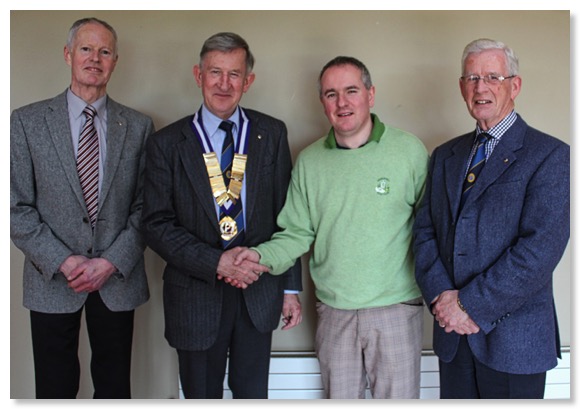
Photo: President Gordon Ward greets Peter Semple, with Club Members Des Moore (L) and Robin Semple (R)
Talk by Peter Semple on "The Plantation of Ulster in Coleraine – A Perspective”
Club President Gordon Ward welcomed members to the meeting and then introduced our speaker for the morning, Mr Peter Semple, whose talk was entitled “The Plantation of Ulster in Coleraine – A Perspective”.
“History is the story of us if we were born in an earlier period”.
A list of hundreds of names ranging from Abbot to McClelland to Younge and Zachery illustrated the personal aspect of those many people who were involved in the Plantation of Ulster indeed the names of many of the Club members were on the list.
The English conquest of Ireland was made piece by piece starting with Henry VIII (1509-1547) and was only completed after sustained warfare in the reign of Elizabeth I (1558-1603). During these wars the force of the semi-independent chieftains was broken, although the success of the victory was limited.
An early Plantation in 1450 was established in an area around Dublin known as the Pale, hence the saying “Outside the Pale”.
The 9 years war (1594-1603) ended in 1603 with the surrender of Hugh O’Neill’s and Hugh O’Donnell’s forces at the Treaty of Mellifort. However when Hugh O’Neill and the other rebel chieftains left Ireland in the “Flight of the Earls” (1607) to seek Spanish help for a new rebellion, O’Neill did not reach Spain but died in Rome in 1616. Lord Deputy Arthur Chichester decided to colonise 6 counties of Ulster. These were the Counties of Coleraine (later to become Co. Londonderry), Donegal, Tyrone, Fermanagh, Cavan and Armagh
In Counties Antrim and Down substantial Presbyterian Scots settlements had been underway since at least 1606, promoted by Hugh Montgomery and James Hamilton. A plantation attempt in Co Monaghan was less successful.
By 1609 the crown had passed to King James Sixth of Scotland, first of England. Even though the Spanish Armada had been repelled, the King feared that the new Kingdom of England and Scotland would be in danger of attack and Ireland could be a stepping stone to further attacks by Spain or France.
Ulster was considered the most rebellious province and therefore a target for “Plantation”. Rather than engage in warfare the King decided that the Plantation of Ulster would be a cheaper option. The confiscated lands would be planted with loyal English and Scottish Protestants.
Lacking funds to complete the plan, King James coerced the City of London companies to finance part of the venture. The twelve London companies formed a body known as “The Honourable The Irish Society. The twelve companies were the Mercers, Clothworkers, Goldsmiths, Salters, Ironmongers, Grocers, Skinners, Vintners, Drapers, Haberdashers, Fishmongers and Merchant Taylors. The twelve London companies resembled the twelve tribes of Israel being guided to the Promised Land. Ulster would be a land flowing with milk and honey with great opportunities for making money. These companies were granted lands throughout the province on the understanding that towns and settlements would be developed. Defences were to be constructed to guard against rebellion or invasion.
Undertakers were also involved in the Plantation. These were wealthy men from England and Scotland who undertook to import tenants from their own estates. Servitors were veterans of the 9 years war who were also rewarded with land grants of their own.
Lands granted to The Hon The Irish Society included areas around Coleraine and Derry, both of which were developed on parallel grid layout. Derry was enclosed by substantial stone walls, while only earthen ramparts were provided in Coleraine. While Derry’s walls have survived through the centuries, only a very small trace of Coleraine’s ramparts have survived in the location to the North of St Patrick’s Church, known locally as The Ramparts. Echoes of the past survive in names such as Kingsgate Street, Blindgate Street, Society Street, The Diamond and The Hon The Irish Society’s School.
The Hon The Irish Society persuaded the King to extend their allocated lands along the Bann valley to Lough Neagh, similarly, in the Foyle valley into East Donegall.
If we look carefully we can see the crests of both London and The Irish Society in the Town Hall windows, the market yard, St Patrick’s Church and many other locations.
St Patrick’s Graveyard contains grave stones of many of the 17th Century settlers.
In 1641 Coleraine stands firm against a rebellion.
Mountsandel Fort is the oldest known settlement in Ireland and Coleraine was from ancient times always a site where people settled.
A legacy of the Plantation – one country, now two communities;
Farming – hedges and fields replace the original open landscape;
Language – English: Towns are developed where previously none existed.
The Plantation is the story of us.
Talk by Peter Semple on "The Plantation of Ulster in Coleraine – A Perspective”
Club President Gordon Ward welcomed members to the meeting and then introduced our speaker for the morning, Mr Peter Semple, whose talk was entitled “The Plantation of Ulster in Coleraine – A Perspective”.
“History is the story of us if we were born in an earlier period”.
A list of hundreds of names ranging from Abbot to McClelland to Younge and Zachery illustrated the personal aspect of those many people who were involved in the Plantation of Ulster indeed the names of many of the Club members were on the list.
The English conquest of Ireland was made piece by piece starting with Henry VIII (1509-1547) and was only completed after sustained warfare in the reign of Elizabeth I (1558-1603). During these wars the force of the semi-independent chieftains was broken, although the success of the victory was limited.
An early Plantation in 1450 was established in an area around Dublin known as the Pale, hence the saying “Outside the Pale”.
The 9 years war (1594-1603) ended in 1603 with the surrender of Hugh O’Neill’s and Hugh O’Donnell’s forces at the Treaty of Mellifort. However when Hugh O’Neill and the other rebel chieftains left Ireland in the “Flight of the Earls” (1607) to seek Spanish help for a new rebellion, O’Neill did not reach Spain but died in Rome in 1616. Lord Deputy Arthur Chichester decided to colonise 6 counties of Ulster. These were the Counties of Coleraine (later to become Co. Londonderry), Donegal, Tyrone, Fermanagh, Cavan and Armagh
In Counties Antrim and Down substantial Presbyterian Scots settlements had been underway since at least 1606, promoted by Hugh Montgomery and James Hamilton. A plantation attempt in Co Monaghan was less successful.
By 1609 the crown had passed to King James Sixth of Scotland, first of England. Even though the Spanish Armada had been repelled, the King feared that the new Kingdom of England and Scotland would be in danger of attack and Ireland could be a stepping stone to further attacks by Spain or France.
Ulster was considered the most rebellious province and therefore a target for “Plantation”. Rather than engage in warfare the King decided that the Plantation of Ulster would be a cheaper option. The confiscated lands would be planted with loyal English and Scottish Protestants.
Lacking funds to complete the plan, King James coerced the City of London companies to finance part of the venture. The twelve London companies formed a body known as “The Honourable The Irish Society. The twelve companies were the Mercers, Clothworkers, Goldsmiths, Salters, Ironmongers, Grocers, Skinners, Vintners, Drapers, Haberdashers, Fishmongers and Merchant Taylors. The twelve London companies resembled the twelve tribes of Israel being guided to the Promised Land. Ulster would be a land flowing with milk and honey with great opportunities for making money. These companies were granted lands throughout the province on the understanding that towns and settlements would be developed. Defences were to be constructed to guard against rebellion or invasion.
Undertakers were also involved in the Plantation. These were wealthy men from England and Scotland who undertook to import tenants from their own estates. Servitors were veterans of the 9 years war who were also rewarded with land grants of their own.
Lands granted to The Hon The Irish Society included areas around Coleraine and Derry, both of which were developed on parallel grid layout. Derry was enclosed by substantial stone walls, while only earthen ramparts were provided in Coleraine. While Derry’s walls have survived through the centuries, only a very small trace of Coleraine’s ramparts have survived in the location to the North of St Patrick’s Church, known locally as The Ramparts. Echoes of the past survive in names such as Kingsgate Street, Blindgate Street, Society Street, The Diamond and The Hon The Irish Society’s School.
The Hon The Irish Society persuaded the King to extend their allocated lands along the Bann valley to Lough Neagh, similarly, in the Foyle valley into East Donegall.
If we look carefully we can see the crests of both London and The Irish Society in the Town Hall windows, the market yard, St Patrick’s Church and many other locations.
St Patrick’s Graveyard contains grave stones of many of the 17th Century settlers.
In 1641 Coleraine stands firm against a rebellion.
Mountsandel Fort is the oldest known settlement in Ireland and Coleraine was from ancient times always a site where people settled.
A legacy of the Plantation – one country, now two communities;
Farming – hedges and fields replace the original open landscape;
Language – English: Towns are developed where previously none existed.
The Plantation is the story of us.
Graham MacDonald
Assistant Secretary