Speaker for Tuesday 4th February 2014 - Prof. Harry McMahon
Talk by Prof. Harry McMahon on 'Art, Statistics and the Troubles'
New Club President Gordon Ward welcomed club members and guest John Springhall to this first meeting of his Presidential year, on a fine sunny morning. Gordon then introduced our speaker for the morning Prof. Harry McMahon, who gave a fascinating and unusual talk on 'Art, Statistics and the Troubles'.
At the beginning of his talk, Harry wanted to thank Ken Parkes (our resident 'audio/visual' guru) for all the help he had provided in making the talk possible.
Harry taught Physics in Grosvenor High School and Methody in the early years of his career before taking a Masters Degree in Education at Leicester University. He then joined the staff of the New University in Coleraine where, in time he became head of the Education Department until his retirement. In starting his talk, Harry told us about his childhood and earlier work years. Even when quite young, Harry found himself regularly at the interface between the two communities in Northern Ireland. This position has had a major influence on his later life and his unique perspective of art. Harry McMahon didn't really take up art seriously until the death of a favourite Uncle, who had always encouraged him. Harry studied part time in Belfast and eventually earned a fine art degree.
Harry then went on to show us example of his work, how they were produced and the inspiration behind them. This was, according to Harry (and in agreement with many, many others), the massive book 'Lost Lives: The Stories of the Men, Women and Children Who Died as a Result of the Northern Ireland Troubles' (see review below).
Harry began by showing how his skills in statistics and maths produced a graph of the people who died in 'the troubles', and how the graph, when rotated, copied and reflected, gave a striking 'cross like' image, which he imposed on various landscape ideas. Harry also showed short videos of making some of his art works based on the statistics from the 'Lost Lives' book and of exhibitions he had set-up. (It is a pity that we were unable to obtain copies of these to show on the club website, as description here would be to long to undertake - sorry folks!).
Some of the more recent work by Harry is based around the 'Anniversary' aspects of the deaths recorded in the 'Lost Lives' book. As an example of this, Harry took the day of the talk - 4th February - which over the years of the troubles had been the day when 12 people had died. Harry read out the names and years the victims were killed. These he had represented as punched holes in railway tickets for the day, encapsulated and displayed on a wall (with many other days) at Great Victoria St. station - (the holes being the 'missing' parts of everyone's journey through life, and bringing home the inter-connectedness of 'the troubles' with everyone's lives).
Harry went on to show part of a UTV news item on his work, and concluded with a look at some if his (more traditional) painted imagery - also see below. Such was the detail and interest in Harry and his work, that there was no time for the regular 'Question and Answer' session.
Noel Gallagher proposed a vote of thanks for Harry, but said that it was very difficult for him to talk, for one of the names for February that Harry had read out (a young man how had died in a London bombing in the docks area in 1996) was a neighbour of Noel when he too was living in London at that time. Noel thanked Harry for a most enlightening, enthralling and emotional talk. The thanks were passed on by the President, who spoke for all the members when he said that this had been one of the most meticulously researched and engrossing talks the club had been fortunate to have. The members showed their appreciation.
The Inspiration for much of Harry McMahon's work:

Lost Lives: The Stories of the Men, Women and Children Who Died as a Result of the Northern Ireland Troubles:
This is a unique work filled with passion and violence, with humanity and inhumanity. It is the story of Northern Ireland troubles told as never before; it is not concerned with the political bickering both with the lives of those who have suffered and deaths which have resulted from more than three decades of conflict.
The authors - four of them Belfast-born and the fifth an American - are journalists and historians. For over a decade, they have examined every single death that was directly caused by the troubles. Their research has seen them interview witnesses, scour published material and draw on a huge range of investigative sources to produce a work of epic proportions. Never before has conflict anywhere in the world been subjected to such meticulous scrutiny.
Lost Lives traces the origins of the conflict from the firing of the first shots, through the carnage of the 1970s and 1980s to the republican and loyalist ceasefires and beyond. All the casualties are here: the RUC officer, the young soldier, the IRA volunteer, the loyalist paramilitary, the Catholic mother, the Protestant worker, the newborn baby. Each account is impossible to ignore.
As a reference book, Lost Lives is indispensable; as a landscape of history painted in fine detail it is unique. For anyone interested in Northern Ireland - or in the human cost of conflict everywhere - this is destined to be the defining work.
Art Work, an example:
Dedicated to all those who have suffered as a result of terrorism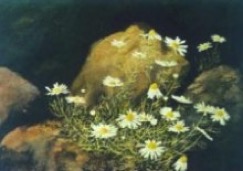
Floral Tribute by Professor Harry McMahon
Floral Tribute was the first image ever printed by The Irish Art Group. Published in February 2001 and dedicated to victims of violence, all proceeds from its sale have gone to organisations involved in peace and reconciliation.
Harry McMahon explains the moving and painful inspiration for the image.
"Like so many others around the world, I was shocked to the core by the events of 11th September 2001, when the people of America, and the world, were caught up in the worst terrorist attack the world has ever seen. My immediate reaction was disbelief and horror, then overwhelming grief at the thought of the suffering being visited upon thousands of innocent people. I recalled how I felt when other terrorists, closer to home, had vented their incoherent anger on the innocent of Omagh, a quiet Irish market town about 40 miles from where I live. Like many others, I laid some flowers. But I wanted to do more and this painting emerged as a more substantial and more lasting floral tribute. To my eye, the twenty nine daisies nestling among the rocks, at their various stages of growth and in all their quiet beauty and fragility, stand as a testimony to the twenty nine innocent lives so tragically cut off in the womb, in childhood, in youth, adulthood and old age. At the time, I dedicated the painting to all those who had suffered as a result of conflict in Ireland, knowing in my bones that we had not yet seen the last atrocity. Little did I realise that two years later I would be re-dedicating the painting to the people of America and of the world whose lives have this week been torn apart and swept away like leaves in a late summer gale. My hope is that the painting, and the sympathy, love, understanding and solidarity it stands for, will bring some little comfort to those who choose to take it as a memento for themselves or for others whom they love."
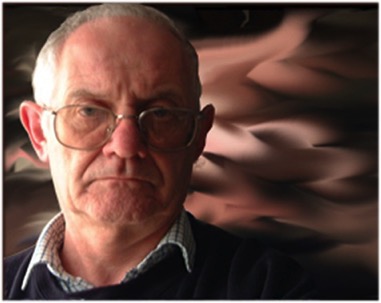
'Self Portrait' - Professor Harry McMahon, Portstewart, Northern Ireland
