Speaker for Tuesday 18th March 2014 - Mr. John Moore
30/03/14 12:42
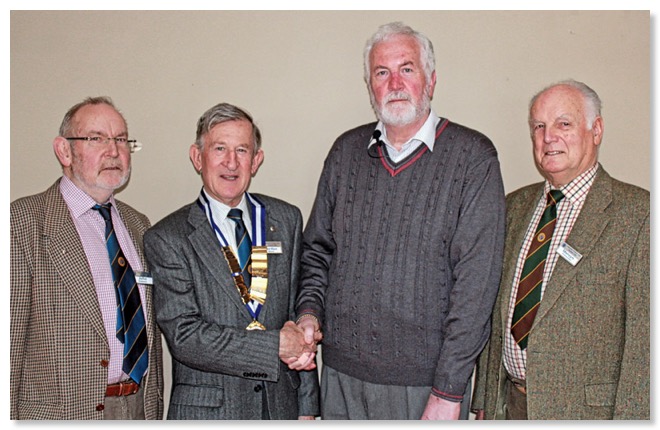
Photo: President Gordon Ward greets John Moore, with Club Members John Dobson (L) and Mervyn Patterson (R)
Talk by John Moore on "The Causeway Tram'
Club President Gordon Ward welcomed members to the meeting and then introduced our speaker for the morning Mr John Moore whose talk was entitled “The Causeway Tram”.
The end of the 19th Century was an exceptional period for engineering projects and Wm A Trail’s promotion of electrical traction engineering was firmly placed in the history of North Antrim.
Previous exploits to promote this form of transportation had little success and in 1879 ended in bankruptcy.
Main railway lines were built in the district with Portrush being reached in 1855. Narrow gauge lines to Ballycastle and Larne were also under construction using a 3 foot gauge. It was anticipated that a branch from the Ballycastle line would eventually reach The Giant’s Causeway This would never be accomplished.
Wm Trail, who lived at Ballyclough House, together with his brother, Dr Anthony Trail, formed a company to develop a tramway from Portrush to Bushmills and The Giant’s Causeway. Share holders in the company included Sir Wm Thompson and Dr Charles Siemens, both of international fame. Ironore and limestone commercial trading projects were identified which would help fund The Company. Objections from local estate landlord W.T. McNaughton were overcome and on 20 August 1880 permission was given to proceed with the construction work.
This was very much an experimental science and the third rail system for the distribution of electrical power was chosen by the Trails. The electric cars could be unreliable and in 1886 steam locomotives were introduced to the route, especially in the towns. Electric power came from the Hydro Plant at Walkmills, Bushmills. The control Engineer was Jubilee Trail Maxwell and at times there was conflict between the engineers, the fishermen and the estate.
The tramway between Portrush and Bushmills was officially opened on 20 September 1883 by The Lord Lieutenant of Ireland with Mr Trail at the controls of the VIP Tram. A branch line to Portrush harbour accommodated the export of ironore and limestone.
The tramways proximity to the main Portrush Railway Station made it popular with the tourists. First class carriages and open toast rack cars gave little protection from the elements. Passenger comfort was not a priority.
On the 1 July 1887 the tramway was extended to The Giant’s Causeway although the track terminated one mile from The Causeway. The small terminal building was imported from Switzerland at a cost of £400.00 and the lattice beam bridge over the River Bush was manufactured in Glasgow.
The Tramway transported tourists to The Causeway Hotel and the Royal Hotel, both located close to The Causeway. A fatal accident condemned the third rail into history and on 26 July 1899 an overhead electric wire system came into use.
In 1888 with the demise of the commercial outlets the goods wagons were converted to passenger use by the staff of the Company. The whole operation was conducted on a make do and mend principle and in 18890 a tram purchased in Dunfermline was modified for use on the tramway. The maintenance shed in Portrush could accommodate all the rolling stock.
During World War II the tramway played an important role in the transportation of American Troops at night to camps close to The Causeway.
While the Causeway tram remained popular with tourists it could not compete with the proliferation of buses and private cars. This combined with price wars hastened the demise of The Causeway Tram and on 15 October 1949 all staff were paid off.
In 1950 the final nail in the coffin was the N. Ireland Government’s refusal to provide the financial support needed and in 1952 the auction of the Company’s assets produced the princely sum of £15,155.00.
Little evidence of this unique and ground breaking tramway remains today.
Talk by John Moore on "The Causeway Tram'
Club President Gordon Ward welcomed members to the meeting and then introduced our speaker for the morning Mr John Moore whose talk was entitled “The Causeway Tram”.
The end of the 19th Century was an exceptional period for engineering projects and Wm A Trail’s promotion of electrical traction engineering was firmly placed in the history of North Antrim.
Previous exploits to promote this form of transportation had little success and in 1879 ended in bankruptcy.
Main railway lines were built in the district with Portrush being reached in 1855. Narrow gauge lines to Ballycastle and Larne were also under construction using a 3 foot gauge. It was anticipated that a branch from the Ballycastle line would eventually reach The Giant’s Causeway This would never be accomplished.
Wm Trail, who lived at Ballyclough House, together with his brother, Dr Anthony Trail, formed a company to develop a tramway from Portrush to Bushmills and The Giant’s Causeway. Share holders in the company included Sir Wm Thompson and Dr Charles Siemens, both of international fame. Ironore and limestone commercial trading projects were identified which would help fund The Company. Objections from local estate landlord W.T. McNaughton were overcome and on 20 August 1880 permission was given to proceed with the construction work.
This was very much an experimental science and the third rail system for the distribution of electrical power was chosen by the Trails. The electric cars could be unreliable and in 1886 steam locomotives were introduced to the route, especially in the towns. Electric power came from the Hydro Plant at Walkmills, Bushmills. The control Engineer was Jubilee Trail Maxwell and at times there was conflict between the engineers, the fishermen and the estate.
The tramway between Portrush and Bushmills was officially opened on 20 September 1883 by The Lord Lieutenant of Ireland with Mr Trail at the controls of the VIP Tram. A branch line to Portrush harbour accommodated the export of ironore and limestone.
The tramways proximity to the main Portrush Railway Station made it popular with the tourists. First class carriages and open toast rack cars gave little protection from the elements. Passenger comfort was not a priority.
On the 1 July 1887 the tramway was extended to The Giant’s Causeway although the track terminated one mile from The Causeway. The small terminal building was imported from Switzerland at a cost of £400.00 and the lattice beam bridge over the River Bush was manufactured in Glasgow.
The Tramway transported tourists to The Causeway Hotel and the Royal Hotel, both located close to The Causeway. A fatal accident condemned the third rail into history and on 26 July 1899 an overhead electric wire system came into use.
In 1888 with the demise of the commercial outlets the goods wagons were converted to passenger use by the staff of the Company. The whole operation was conducted on a make do and mend principle and in 18890 a tram purchased in Dunfermline was modified for use on the tramway. The maintenance shed in Portrush could accommodate all the rolling stock.
During World War II the tramway played an important role in the transportation of American Troops at night to camps close to The Causeway.
While the Causeway tram remained popular with tourists it could not compete with the proliferation of buses and private cars. This combined with price wars hastened the demise of The Causeway Tram and on 15 October 1949 all staff were paid off.
In 1950 the final nail in the coffin was the N. Ireland Government’s refusal to provide the financial support needed and in 1952 the auction of the Company’s assets produced the princely sum of £15,155.00.
Little evidence of this unique and ground breaking tramway remains today.
Graham MacDonald - Assistant Secretary