Speaker for Tuesday 6th May 2014 - Mr. Desmond Johnston
10/05/14 07:42
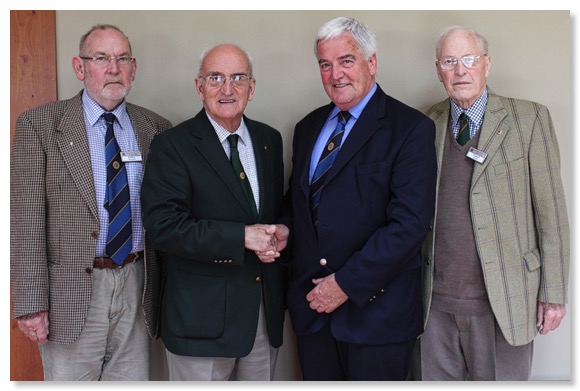
Photo: Vice President John Graham greets Speaker and Club Member Des Johnston, with other Members John Dobson (L) and Cecil Leitch (R)
Transcript of a talk by Des Johnston titled "An Inspector calls"
(WebEd; yes, Des was a 'School Inspector)
As I look round this distinguished audience I have two initial thoughts: the first is an echo of Stan or is it Ollie who always could be trusted to say at some point, IIThis is another nice mess you've got us into". I know how I got into this mess, I spoke to John McHenry in an off guarded moment and he cajoled me into it. Let that be a warning for all of you. The second thought is that given the presence of a few superannuated educationalists among you, I should stress that what follows has no relation to any person or persons present in this room. Unlike the authors of fiction I do not need, however, to affirm that it bears no relation to any individual. All those who figure in what follows actually exist.
I spent over half of my working life, 28 ½ years to be precise, in the Department of Education for Northern Ireland Inspectorate, later renamed the Education and Training Inspectorate. That period made me the longest-serving inspector of the modern era. Sometimes people referred to us as HMI, Her Majesty's Inspectors. While this was not strictly correct, it was common shorthand. In fact, the DENI (as it was before we lost the Northern Ireland from our parent Department name as a consequence of political niceties had an Inspectorate before the HMI came into existence in England, Wales and Scotland. Be that as it may I am sure that the young lad who tugged at my trouser seam and asked, "Hi mister, are you the Queen's spectre?" was not aware of the historical dimension. I am sure that his Freudian slip might have resonated in the minds of a few who saw in us the spectre at the feast, about as welcome as Banquo's ghost in Macbeth.
For my part, I consider it to have been a great privilege to have observed committed professionals at work and to have engaged with them in discussion about how the learning experiences of children and young people could be enhanced. There were rare occasions when I encountered those who were less than professional or who should never have been in the teaching profession because they had little rapport with children or commitment to what they were supposed to be doing.
Over the 28 ½ years I had a wide variety of experiences, some amusing, enriching, some puzzling, some awkward and a few distressing.
To give an example of the last of these. Unfortunately not every parent, as the media makes us all too aware on a regular basis, have their child's best interests at heart. I was in my early days in the Inspectorate when I went with an experienced colleague to visit a school in a deprived area of Belfast. We were informed by the principal that one of his pupils went home each day to a house in which his often intoxicated mother ran a virtual one-woman brothel. On another visit I learnt of a pupil who suffered an eye injury on a Saturday and arrived in school on Monday with a severe eye infection. He was immediately taken by the principal to hospital and his eye was saved. His mother too had been in a stupor all weekend. Encountering, even second-hand, these distressing social problems faced by some children were among the darker moments of the job. For such children their time in school, as for the majority, is (? - *sorry, not clear ). They were thankfully in the minority and (?*).
I'd like to introduce you now to some of the characters I have met or have heard of from colleagues. Some seemed to operate to a time system of their own. There was the lady principal of a two-teacher primary school in Fermanagh who was rumoured to take herself out of the classroom and into the adjoining schoolhouse on a regular basis for a wee break. The local inspector got wind of this and took to calling frequently at different times of the day, but was never able to catch her out. After a number of visits, she decided she had to get rid of this troublesome person who was disturbing her peace and said on his next visit, "Mr, So-and-so, I feel I have to ask you what your intentions are, because people in the village are starting to talk". Another, the male principal of a similar size of school regularly arrived after the official starting time of the school day. On one occasion one of my predecessors hid in a hedge (I jest not) and jumped out with the triumphant cry, IILate again, Mr X", as the principal rode past on his bicycle. On a later occasion, during my time as the district inspector, I arrived at the school at 9:30 to find that neither teacher was there and the children were milling around the playground. The assistant teacher arrived sheepishly some minutes later and the principal eventually turned up just before 10 and failed to appreciate that he and not the caretaker was responsible for the children's safety when they were on the school premises.
Then there was the eccentric history teacher who was actually my own teacher. He once had a visit from an inspector who was probably gobsmacked when the teacher invited him to assess the pupils' knowledge and stepping out through the door told the inspector that he would be in the staffroom if the inspector wished to speak to him. It's probably worth noting that the teacher hadn't a single failure in A level history throughout his career.
I have had my fair share of embarrassing moments. Probably one of the more alarming involved a visit to a P4 class in Lisburn. I had been looking through the teacher's schemes of work and noticed that she had listed the rope works among the major industries of Belfast. As this was a number of years after the rope works had closed I ventured the comment that she might need to make a few revisions to her schemes of work. At this point there was a slight movement and she slipped down slowly and gracefully in a faint onto the floor. I resisted the temptation to give her the kiss of life and sent a pupil to fetch the principal and she quickly revived.
On another occasion I was in a school in North Antrim when the teacher I was with suddenly said, "I remember something you said to me 20 years ago". For a moment I was somewhat alarmed at the prospect of my words coming back to haunt me. Fortunately, it had been a bit of praise and encouragement, but it taught me a lesson which I shared with younger, new colleagues about the need to weigh one's words carefully, to make sure that anything one said was based on firm evidence and to be sure to give encouragement and positive comment where it was merited.
Being an inspector throughout most of the period of our most serious troubles involved some potentially hairy moments. One of my colleagues was the district inspector for Derry/Londonderry in the mid 70s. and was based in the city. It was considered a tad dangerous for colleagues to visit the city, since many of the schools were in areas of high paramilitary activity. As a result they arrived in the city by train, were met at the station by this colleague and then driven to the schools they had to visit. On one occasion one was stopped at an IRA barricade; when this happened there was bit of a kerfuffle until a priest arrived and resolved the problem by stating that it was fine; "This was Mr. X the school inspector and a colleague" and they were let through without further ado.
I had responsibility for inspecting languages in South Armagh for a couple of years and had to visit Crossmaglen on one occasion. In the main square in the town there was an army checkpoint and a small squaddie approached my window. I was asked where I was going and what my business was. On hearing that I was a school inspector he said, III don't fancy your job". My eyes swept round the square where the young soldier was exposed to obvious danger and I retorted with a laugh, "That's good coming from you". On leaving the school I intended to head for Keady. I thought it better to check my map in the schoolyard, rather than be seen reading a map on the open road somewhere. Having checked I headed off following the signposts. After a while I became aware that the road was getting narrower and there was grass down the centre of it. It began to dawn on me that some kind soul had rotated the signpost and 1 thought I might well be on what we once called an "unapproved road". Eventually I approached a larger road, I thought to myself, IIlf the road signs and markings are yellow I will have crossed the border by an unapproved road. And so it was. Hitting the main road I sank the boot and hightailed it for Keady.
When I was out on the road travelling between schools around lunchtime I would frequently have a sandwich and flask with me and would often seek out a river or a lake beside which to have my lunch and possibly to indulge in a few minutes birdwatching. Thus it was I found myself beside Camlough Lake in South Armagh. I had had my lunch and was just reaching down to lift my binoculars and study some ducks on the lake when I stopped dead. There I was in South Armagh, about to lift a pair of binoculars and in a car with several large-scale ordnance survey maps. Some explanation might well have been required of me had I been spotted.
Despite the (?*) I only had to run the gauntlet of barricades twice and never had to break off a journey. Admittedly, the barricades were small, with only a couple of young fellows and no major obstacle. They could easily be passed by taking to the pavement. Impartiality obliges me to note that one was on the Castlerock Road during some workers' protest and the other in Twinbrook.
Twinbrook was the scene of two other interesting experiences. A colleague and myself were invited to a celebration involving the two Catholic schools in the estate. Part of the celebration involved walking in procession between the schools. At the head of the procession was Bishop Philbin. As he had recently spoken out against the IRA he was subject to a barrage of abuse from the footpaths. I found it ironic that two prods were walking quietly along unnoticed. It was also in Twinbrook that there was a problem with one of the schools being used as a polling station. The Army had to occupy the school overnight to protect the voting boxes. Some elements of the IRA took it upon themselves to warn the principal that if he didn't get the army out they would burn his school. His sage reply was/'What do you mean MY school, it's your school".
(Some ‘quotes’ from nameless pupils and reports)
"I went to the dentist, he got a thrill and put it into my mouth".
“My aunt is a witch and she makes offal spells".
"I like the heart attack. He helps us. He makes houses".
“This is a joe carriageway".
"These are my boobies" (P.l child having shoved pine cones up her blouse).
"Dinne greet, ye 'dinne hae to hae yer ane".
“Two insneakers are in school" (Freudian error overheard).
"Mood means that you have no cloas". Teacher noted "No. That is nude".
Transcript of a talk by Des Johnston titled "An Inspector calls"
(WebEd; yes, Des was a 'School Inspector)
As I look round this distinguished audience I have two initial thoughts: the first is an echo of Stan or is it Ollie who always could be trusted to say at some point, IIThis is another nice mess you've got us into". I know how I got into this mess, I spoke to John McHenry in an off guarded moment and he cajoled me into it. Let that be a warning for all of you. The second thought is that given the presence of a few superannuated educationalists among you, I should stress that what follows has no relation to any person or persons present in this room. Unlike the authors of fiction I do not need, however, to affirm that it bears no relation to any individual. All those who figure in what follows actually exist.
I spent over half of my working life, 28 ½ years to be precise, in the Department of Education for Northern Ireland Inspectorate, later renamed the Education and Training Inspectorate. That period made me the longest-serving inspector of the modern era. Sometimes people referred to us as HMI, Her Majesty's Inspectors. While this was not strictly correct, it was common shorthand. In fact, the DENI (as it was before we lost the Northern Ireland from our parent Department name as a consequence of political niceties had an Inspectorate before the HMI came into existence in England, Wales and Scotland. Be that as it may I am sure that the young lad who tugged at my trouser seam and asked, "Hi mister, are you the Queen's spectre?" was not aware of the historical dimension. I am sure that his Freudian slip might have resonated in the minds of a few who saw in us the spectre at the feast, about as welcome as Banquo's ghost in Macbeth.
For my part, I consider it to have been a great privilege to have observed committed professionals at work and to have engaged with them in discussion about how the learning experiences of children and young people could be enhanced. There were rare occasions when I encountered those who were less than professional or who should never have been in the teaching profession because they had little rapport with children or commitment to what they were supposed to be doing.
Over the 28 ½ years I had a wide variety of experiences, some amusing, enriching, some puzzling, some awkward and a few distressing.
To give an example of the last of these. Unfortunately not every parent, as the media makes us all too aware on a regular basis, have their child's best interests at heart. I was in my early days in the Inspectorate when I went with an experienced colleague to visit a school in a deprived area of Belfast. We were informed by the principal that one of his pupils went home each day to a house in which his often intoxicated mother ran a virtual one-woman brothel. On another visit I learnt of a pupil who suffered an eye injury on a Saturday and arrived in school on Monday with a severe eye infection. He was immediately taken by the principal to hospital and his eye was saved. His mother too had been in a stupor all weekend. Encountering, even second-hand, these distressing social problems faced by some children were among the darker moments of the job. For such children their time in school, as for the majority, is (? - *sorry, not clear ). They were thankfully in the minority and (?*).
I'd like to introduce you now to some of the characters I have met or have heard of from colleagues. Some seemed to operate to a time system of their own. There was the lady principal of a two-teacher primary school in Fermanagh who was rumoured to take herself out of the classroom and into the adjoining schoolhouse on a regular basis for a wee break. The local inspector got wind of this and took to calling frequently at different times of the day, but was never able to catch her out. After a number of visits, she decided she had to get rid of this troublesome person who was disturbing her peace and said on his next visit, "Mr, So-and-so, I feel I have to ask you what your intentions are, because people in the village are starting to talk". Another, the male principal of a similar size of school regularly arrived after the official starting time of the school day. On one occasion one of my predecessors hid in a hedge (I jest not) and jumped out with the triumphant cry, IILate again, Mr X", as the principal rode past on his bicycle. On a later occasion, during my time as the district inspector, I arrived at the school at 9:30 to find that neither teacher was there and the children were milling around the playground. The assistant teacher arrived sheepishly some minutes later and the principal eventually turned up just before 10 and failed to appreciate that he and not the caretaker was responsible for the children's safety when they were on the school premises.
Then there was the eccentric history teacher who was actually my own teacher. He once had a visit from an inspector who was probably gobsmacked when the teacher invited him to assess the pupils' knowledge and stepping out through the door told the inspector that he would be in the staffroom if the inspector wished to speak to him. It's probably worth noting that the teacher hadn't a single failure in A level history throughout his career.
I have had my fair share of embarrassing moments. Probably one of the more alarming involved a visit to a P4 class in Lisburn. I had been looking through the teacher's schemes of work and noticed that she had listed the rope works among the major industries of Belfast. As this was a number of years after the rope works had closed I ventured the comment that she might need to make a few revisions to her schemes of work. At this point there was a slight movement and she slipped down slowly and gracefully in a faint onto the floor. I resisted the temptation to give her the kiss of life and sent a pupil to fetch the principal and she quickly revived.
On another occasion I was in a school in North Antrim when the teacher I was with suddenly said, "I remember something you said to me 20 years ago". For a moment I was somewhat alarmed at the prospect of my words coming back to haunt me. Fortunately, it had been a bit of praise and encouragement, but it taught me a lesson which I shared with younger, new colleagues about the need to weigh one's words carefully, to make sure that anything one said was based on firm evidence and to be sure to give encouragement and positive comment where it was merited.
Being an inspector throughout most of the period of our most serious troubles involved some potentially hairy moments. One of my colleagues was the district inspector for Derry/Londonderry in the mid 70s. and was based in the city. It was considered a tad dangerous for colleagues to visit the city, since many of the schools were in areas of high paramilitary activity. As a result they arrived in the city by train, were met at the station by this colleague and then driven to the schools they had to visit. On one occasion one was stopped at an IRA barricade; when this happened there was bit of a kerfuffle until a priest arrived and resolved the problem by stating that it was fine; "This was Mr. X the school inspector and a colleague" and they were let through without further ado.
I had responsibility for inspecting languages in South Armagh for a couple of years and had to visit Crossmaglen on one occasion. In the main square in the town there was an army checkpoint and a small squaddie approached my window. I was asked where I was going and what my business was. On hearing that I was a school inspector he said, III don't fancy your job". My eyes swept round the square where the young soldier was exposed to obvious danger and I retorted with a laugh, "That's good coming from you". On leaving the school I intended to head for Keady. I thought it better to check my map in the schoolyard, rather than be seen reading a map on the open road somewhere. Having checked I headed off following the signposts. After a while I became aware that the road was getting narrower and there was grass down the centre of it. It began to dawn on me that some kind soul had rotated the signpost and 1 thought I might well be on what we once called an "unapproved road". Eventually I approached a larger road, I thought to myself, IIlf the road signs and markings are yellow I will have crossed the border by an unapproved road. And so it was. Hitting the main road I sank the boot and hightailed it for Keady.
When I was out on the road travelling between schools around lunchtime I would frequently have a sandwich and flask with me and would often seek out a river or a lake beside which to have my lunch and possibly to indulge in a few minutes birdwatching. Thus it was I found myself beside Camlough Lake in South Armagh. I had had my lunch and was just reaching down to lift my binoculars and study some ducks on the lake when I stopped dead. There I was in South Armagh, about to lift a pair of binoculars and in a car with several large-scale ordnance survey maps. Some explanation might well have been required of me had I been spotted.
Despite the (?*) I only had to run the gauntlet of barricades twice and never had to break off a journey. Admittedly, the barricades were small, with only a couple of young fellows and no major obstacle. They could easily be passed by taking to the pavement. Impartiality obliges me to note that one was on the Castlerock Road during some workers' protest and the other in Twinbrook.
Twinbrook was the scene of two other interesting experiences. A colleague and myself were invited to a celebration involving the two Catholic schools in the estate. Part of the celebration involved walking in procession between the schools. At the head of the procession was Bishop Philbin. As he had recently spoken out against the IRA he was subject to a barrage of abuse from the footpaths. I found it ironic that two prods were walking quietly along unnoticed. It was also in Twinbrook that there was a problem with one of the schools being used as a polling station. The Army had to occupy the school overnight to protect the voting boxes. Some elements of the IRA took it upon themselves to warn the principal that if he didn't get the army out they would burn his school. His sage reply was/'What do you mean MY school, it's your school".
(Some ‘quotes’ from nameless pupils and reports)
"I went to the dentist, he got a thrill and put it into my mouth".
“My aunt is a witch and she makes offal spells".
"I like the heart attack. He helps us. He makes houses".
“This is a joe carriageway".
"These are my boobies" (P.l child having shoved pine cones up her blouse).
"Dinne greet, ye 'dinne hae to hae yer ane".
“Two insneakers are in school" (Freudian error overheard).
"Mood means that you have no cloas". Teacher noted "No. That is nude".