Speaker for Tuesday 1st April 2014 - Mr. Stephen Peden
Talk by Stephen Peden - 'Fire Fighter'
Club President Gordon Ward welcomed members to the meeting and then introduced our speaker for the morning, Mr Stephen Peden, whose talk was entitled “Fire Fighter”.
To the general public the Fire Service equates to the large red fire engine travelling at high speed, eventually spraying water on a burning building to extinguish the flames.
This view contains a modicum of truth but after 30 years of full time service, Stephen’s job description has changed dramatically. The public view often reflects a failure by the Fire Service to educate and instruct.
Today the Fire and Rescue Service has a dedicated Department responsible for fire prevention and education with 500 smoke detectors being fitted for the general public. New buildings have now, by law, to be fitted with dedicated fire detectors.
Northern Ireland has an area of 5,500 square miles consisting of cities, towns, villages and countryside with the Fire and Rescue Structure headquarters and control located in Lisburn with links to 4 area commands.
Personnel consist of 917 whole time and 994 retained fire fighters with 12 volunteers on Rathlin Island and 58 control staff. 208 support staff are located at Headquarters.
An interesting fact – all fire fighters must be clean shaven. A rule which the volunteers from Rathlin Island had reluctantly to accept.
Work shift pattern – 2 shifts; 9.00 – 18.00 hrs and 18.00 to 9.00hrs. Variable crewing shift – 7.30 – 19.30hrs.
Mobilisation: The retained fire fighter will log into the fire station 5 minutes after paging, while the whole time crew must mobilise in 90 seconds. The retained crew will mobilise in 8 minutes; journey time to fire location 4 to 20 minutes.
All fire appliances now carry medical equipment.
Stephen gave vivid description of harrowing events he was involved in during the “Troubles” ranging from a serious fire at Lindsay Cars in Ballymena to bomb attacks in Londonderry.
The Fire and Rescue Service can also be involved in Road Traffic Collisions, Rescue from heights, rescue from collapsed buildings and even the rescue of a cat from a tree is looked on as a useful training session.
In September 2013 six appliances were called to Portstewart beach to extinguish a grass fire in the sand dunes. A fire which was set deliberately and the cost of this vandalism was in the region of £15,000.00. Bog fires also create problems during the summer periods.
A 999 emergency phone call can be connected to a BT operator anywhere in the United Kingdom where it will be traced to a registered address. The information is then passed to the Fire & Rescue control centre in Lisburn, the address checked and the Fire Units activated.
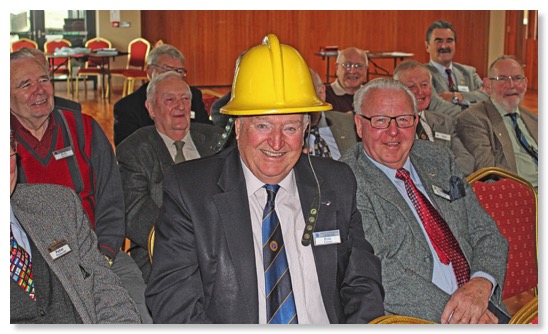
Eric ALWAYS wanted to be a fireman, and Stephen gave him his big chance!
Stephen provided an interesting display of both old and up-to-date equipment illustrating the considerable improvement in helmets, tunics, gloves and dedicated fire boots. A modern kit can cost £1,800.00 per set.
The breathing apparatus alone costs £2,500.00 and can be used for a period of 45 minutes. This can reduce to 10 minutes depending on the work rate.
In spite of all the advancement, the old safety line is still a useful piece of equipment.
A vote of thanks was proposed by Jim Archer who expressed all our thanks for a most interesting and entertaining talk. The thanks were passed on by the President. The members showed their appreciation.
Graham MacDonald - Assistant Secretary
