Speaker for 8th November 2016
Coleraine Probus and 'Remembrance'
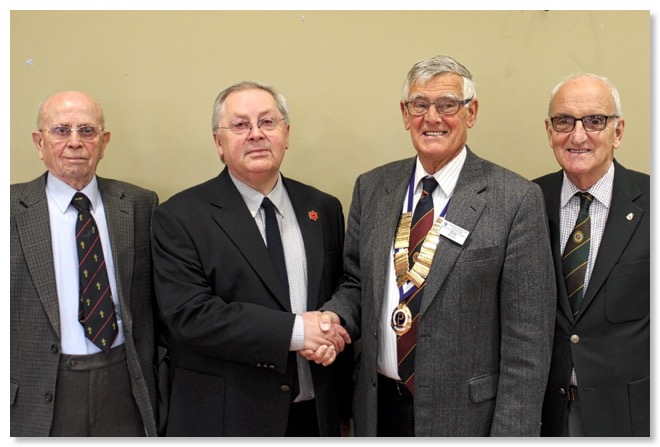
Appropriately for a November meeting, Coleraine Probus were pleased to host Ken Wood, a retired teacher, photographer and WW1 historian. Ken gave a fully illustrated talk on 'Remembrance', in particular the many war memorials, their history and differing styles, as well as the story of the 'Poppy Appeal'.
War memorials were erected to provide a focus for families who would never be able to get to see where their loved ones were buried, however they were also heavily criticised as the money spent on them could have been spent on the returning wounded and the widows. Many parishes opted for the 'Role of Honour' scrolls erected outside (these days inside) the local church. Ken pointed out that for the WW1 plaques the dates are normally 1914 to 1919. This is because the armistice was 1918, but the was didn't officially end until the following year.

Such were the numbers of soldiers killed during the First World War, it wasn't possible to remove all to recognised cemeteries, and so they were often buried where they fell. The Menin Gate Memorial to the Missing in Ypres has over 55,000 names inscribed on its walls, for the fallen who have no marked grave.
Ken went on to show a wide selection of war memorials he had photographed from around the UK. These gave a wide range of styles - thoughtful, sad, defiant, enthusiastic and compassionate. There was also some images of the 'Shot at Dawn' memorial to the 360 men executed, mainly for 'cowardice' but now recognised stress or 'shell shock'.
The Poppy Appeal has its origins one Anna Guérin: “The French Poppy Lady”, who introduced the idea to Earl Haig (although it is thought that she in turn was inspired by the poem 'In Flanders Fields' by John McCrae *See below). The 'Haig Poppy Fund' was set up to aid the widows of soldiers, who made the Poppy badges for sale for the one day - 11th November - each year. This developed and grew over the years and had a name change in 1994 to 'The Poppy Appeal'. Incidentally, before the 'Poppy' became so popular, the 'Forget-me-not' was the flower to ware for lost loved ones.

Ken Wood finished his talk with a mention of 'Thankful Villages', something club members hadn't heard of. There are a total of 55 of these in the UK and are so named as they are places where groups of men enlisted in the army, and all the men returned after the war. Sadly there are none of these villages in Scotland or Northern Ireland.
A quick question from Ken - "Do you know haw many names are on the Coleraine memorial?" The answer is 173, a big sacrifice for our town, and a big debt to be remembered each November.
Poppy and War Memorials Extras:

A memorial to the Horses of WW1 - a note from Ken: there were more horses killed than men between the years 1914 - 1918
For more info about 'The Poppy Appeal', just 'Click' here (This will open in a new window)
John McCrae - 'In Flanders Fields' - May 1915
In Flanders fields the poppies blow
Between the crosses, row on row,
That mark our place; and in the sky
The larks, still bravely singing, fly
Scarce heard amid the guns below.
We are the Dead. Short days ago
We lived, felt dawn, saw sunset glow,
Loved and were loved, and now we lie
In Flanders fields.
Take up our quarrel with the foe:
To you from failing hands we throw
The torch; be yours to hold it high.
If ye break faith with us who die
We shall not sleep, though poppies grow
In Flanders fields.
For more info about John McCrae and the Poppy of WW1, just ‘Click’ this link

The recently erected statue to Sergeant Robert Quigg VC (28 February 1885 – 14 May 1955) at Bushmills
For more information about Sgt. Quigg, 'Click' this link