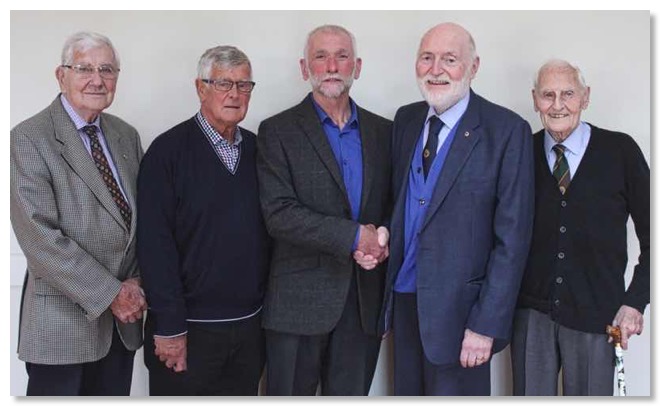
Speaker for 3rd September 2019
Coleraine Probus goes mining around Portrush
The President gave a warm welcome to the members and guest Rory McCarroll who is a member of Riada Probus Club. He then introduced the morning's speaker, Geoff Warke, the topic of his talk being “Mining around Portrush”. This surprised members to learn there even was a mining industry around Portrush in the 19th and 20th centuries.
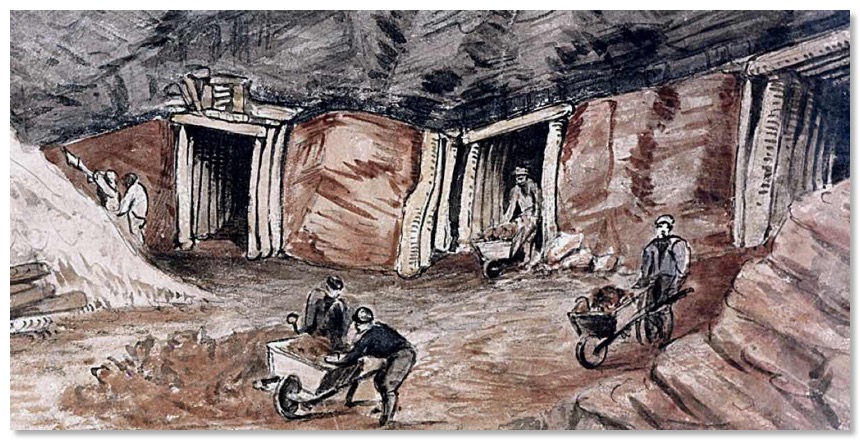
To put things into a historical and province wide prospective, Geoff gave an outline of the growth of the mining industry in Northern Ireland. Within NI there have been (and some remain) several mine types. These include workings for iron ore; bauxite; coal; salt; lead; fireclay; lignite (or 'Irish Coal') and gold, all of which Geoff indicated on a mining map of the province (see below).

Uniquely to Northern Ireland, it is the Government of NI, not the mining companies themselves, that is responsible for the safety of these mines, to the public and the environment. Geoff illustrated just what could go wrong, in his excellent presentation and showed just why the NI Geological Survey staff, have to carry out regular inspections.
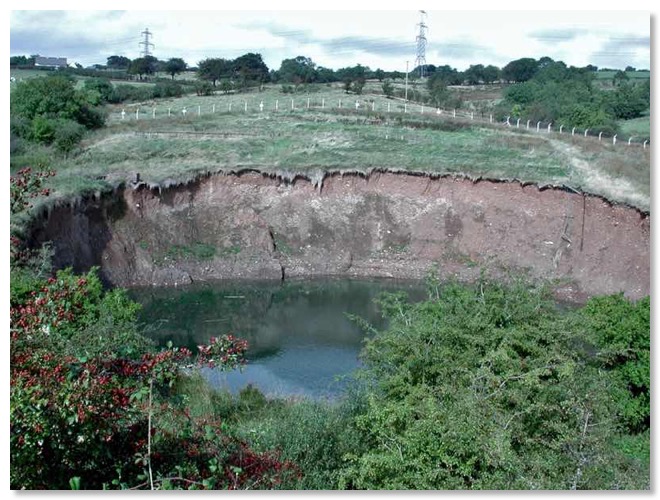
Maidenmount Salt Mine in 2002, after a serious collapse!
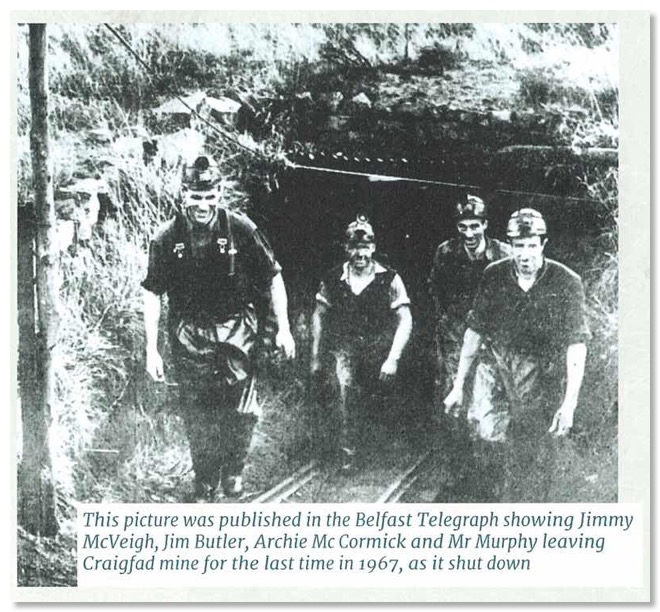
Between the mid 1700s up to the present day, there have been over 2400 registered mine workings. Nearly all are now closed, but the sites still need to be monitored. There is plenty of visible evidence of these mines, as old engine houses and tall chimney stacks can often be spotted on, for instance a trip into the hills of Antrim. Members were quite surprised to be told that neighbouring Ballycastle had a working coalfield from the mid 1750s up until 1967. Its peak performance was during WWII, when it mined up to 5,000 tones of coal a year!
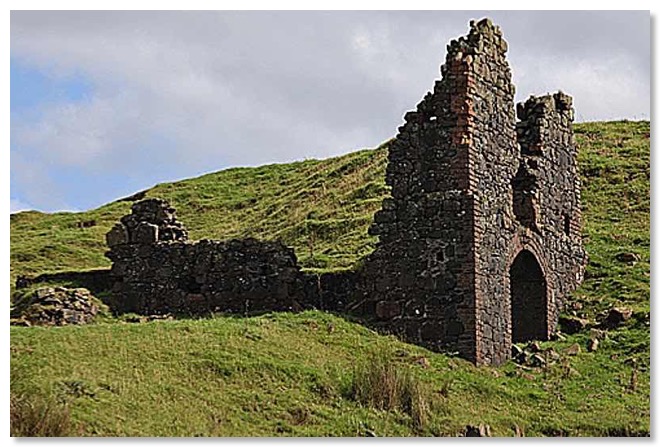
More locally, the 'Portrush District' information shows that the main mining in our own area was for Iron Ore. Although the official statistics are not complete, it is possible to trace a pretty accurate and unique record of local mining from the archives of our local newspapers. From The Coleraine Chronicle we learn that 'Captain Haney' (his Army rank seems to change over the years!) opened his first Portrush mine in 1870, and by 1875 this was producing around 10,000 tons a year. By 1877, 'Cornel Haney' was reported in the newspapers to be opening new mines, to increase his shipping trade, exporting the Ore to the North of England and Scotland, and then returning the ships to Portrush and Coleraine loaded with Coal. By 1880, the largest Iron Smelter in the World was in Barrow-in-Furness; this was substantially supplied by the Ore from the 'Portrush District' and Cornel Haney's ships - which numbered (according to the Coleraine Chronicle of the time) at over 100, that were exporting the local Iron Ore.

As the 1800s gave way to the 1900s, so the mine workings went into decline. Interestingly the 1911 Census still listed the occupation of 'Miners' in our area. Our local newspapers, into the 1920s still carried advertisements for the sale local 'Irish Coal'. The last working Coal Mine in Northern Ireland, finally closed in 1967. Now the only real and permanent reminder of those days of mining prosperity, digging and danger, are the secured old mine entrances and the regular inspections carried out by the staff of the NI Geological Survey.
Geoff is to be congratulated for the meticulous and painstaking research that has gone into his extensive and so very interesting club talk and presentation.
(Thanks to Graham for his help with this report)
*For members that may wish to find out more about Mining in our area AND the rest of Northern Ireland, check at your nearest Museum (or phone: 028 2075 2100) for a copy of this interesting booklet from the 'Causeway Coast and Glens Heritage Trust', which our speaker, Geoff Warke helped to compile:-