Speaker for Tuesday 8th January 2013 - Robin Wlash
10/01/13 18:30
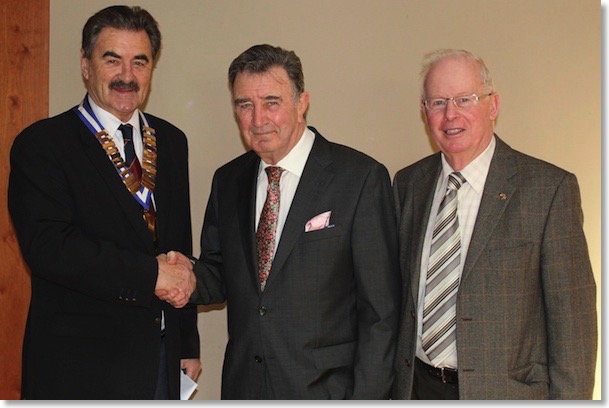
Photo: President Ross Torrens welcomes Robin Walsh, with Speaker’s Sub-committee coordinator, John McHenry
Talk by Robin Walsh, retired controller of BBC NI
Mr Walsh thanked the members for the opportunity to speak to then, and reported that he had met our President Ross Torrens for the first time when they had played on opposing Under 15s Cricket Teams!
Robin said that the subject of the National Lottery would take about ten minutes (which may be longer than it takes to play, but nothing like as long as it takes to win anything - WebEd) and would then take a trip down memory lane as he remembered some of the incident during his time with the BBC and UTV.
National Lottery
Considered to be the most successful in the world, the lottery has been going for around 18 years and has created 3,000 millionaires.
Selection of Numbers
Although there are some sets of unique numbers (hence single winners) most selections will have up to 10,000 other people with the same set!
Where does the money go?
28% goes to 'Good Causes' (that's some £30 Billion so far). The rest is ploughed back: Prizes, Lottery outlets, Sports promotions, etc. There are very few places in the UK that haven't benefited from Lottery funding in one way or another - and that includes Coleraine
Memory Lane
Robin then gave the members an insight into how the media coped with cover of 'The Troubles'
In 1969 Robin was news editor with UTV. At that time there were only 4 or 5 journalists and 2 camera crews in the newsroom. With so much going on across the province, resources were severely stretched. ITN then helped out with an extra 3 reporters and 3 film crews. Robin then went of to recall many of the principal ITN reporters working there at the time, including Sir Trevor McDonald. Then there was the problem of what to report and what not to report? Some people had the theory 'stop reporting incidents and the troubles will go away!' This idea was supported by the then Secretary of State Roy Mason, but he was soon convinced that the theory was flawed. At one stage the Government were considering ending internment, which was a worry for the Provisional IRA, as internment was the best 'recruiting sergeant' they had. The PIRA then stepped up their activities to ensure that internment didn't end.
What to show on TV?
In general, there is the principal of 'the greater the significance, the greater the need to show it, eg, the events of 'Bloody Sunday'. There also has to be a balance. Bad news: Bombs etc. vs 'feel good' factor (eg, Mary Peters 1972 Gold Medal). TV coverage had to be seen to be fair and impartial, personal feeling needed to be left outside the studio. Robin told the members how on one occasion his wife and two daughters were on a bus that passed a nearby bomb detonation. Thankfully, no one was hurt, but a matter of seconds later and he could not have continued in the job without personal feelings getting in the way.
Robin went on to recall the 'Ulster Workers Strike' as well as his encounters with personalities such as Ian Paisley, John Hume and leaders of the strike. However, the men he admired most were the camera teams who had to keep going despite any personal risk, or the story would be lost for the news.
The talk concluded with a short but highly interesting question and answer session. In fact the talk could have gone on for a much longer time, but time was running out. A vote of thanks was proposed by Aubrey McElhinney to Robin Walsh for his thoughtful and engrossing talk.
The President passed on our thanks, and the members showed their appreciation.
Talk by Robin Walsh, retired controller of BBC NI
Mr Walsh thanked the members for the opportunity to speak to then, and reported that he had met our President Ross Torrens for the first time when they had played on opposing Under 15s Cricket Teams!
Robin said that the subject of the National Lottery would take about ten minutes (which may be longer than it takes to play, but nothing like as long as it takes to win anything - WebEd) and would then take a trip down memory lane as he remembered some of the incident during his time with the BBC and UTV.
National Lottery
Considered to be the most successful in the world, the lottery has been going for around 18 years and has created 3,000 millionaires.
Selection of Numbers
Although there are some sets of unique numbers (hence single winners) most selections will have up to 10,000 other people with the same set!
Where does the money go?
28% goes to 'Good Causes' (that's some £30 Billion so far). The rest is ploughed back: Prizes, Lottery outlets, Sports promotions, etc. There are very few places in the UK that haven't benefited from Lottery funding in one way or another - and that includes Coleraine
Memory Lane
Robin then gave the members an insight into how the media coped with cover of 'The Troubles'
In 1969 Robin was news editor with UTV. At that time there were only 4 or 5 journalists and 2 camera crews in the newsroom. With so much going on across the province, resources were severely stretched. ITN then helped out with an extra 3 reporters and 3 film crews. Robin then went of to recall many of the principal ITN reporters working there at the time, including Sir Trevor McDonald. Then there was the problem of what to report and what not to report? Some people had the theory 'stop reporting incidents and the troubles will go away!' This idea was supported by the then Secretary of State Roy Mason, but he was soon convinced that the theory was flawed. At one stage the Government were considering ending internment, which was a worry for the Provisional IRA, as internment was the best 'recruiting sergeant' they had. The PIRA then stepped up their activities to ensure that internment didn't end.
What to show on TV?
In general, there is the principal of 'the greater the significance, the greater the need to show it, eg, the events of 'Bloody Sunday'. There also has to be a balance. Bad news: Bombs etc. vs 'feel good' factor (eg, Mary Peters 1972 Gold Medal). TV coverage had to be seen to be fair and impartial, personal feeling needed to be left outside the studio. Robin told the members how on one occasion his wife and two daughters were on a bus that passed a nearby bomb detonation. Thankfully, no one was hurt, but a matter of seconds later and he could not have continued in the job without personal feelings getting in the way.
Robin went on to recall the 'Ulster Workers Strike' as well as his encounters with personalities such as Ian Paisley, John Hume and leaders of the strike. However, the men he admired most were the camera teams who had to keep going despite any personal risk, or the story would be lost for the news.
The talk concluded with a short but highly interesting question and answer session. In fact the talk could have gone on for a much longer time, but time was running out. A vote of thanks was proposed by Aubrey McElhinney to Robin Walsh for his thoughtful and engrossing talk.
The President passed on our thanks, and the members showed their appreciation.
(Notes by Jim Foote and Mike Turner)